
What Is Internet Hosting? A Simple Beginner’s Guide
Think of the internet as a digital city. If you want to build a shop there, you need a piece of land to build on. This land is called internet hosting.
Simply, internet hosting is the space you rent on a powerful computer called a server to store your website’s files, photos, and videos. Without it, your website has nowhere to live and can’t be seen by the world.
In simple words, we will answer the question ”what is internet hosting”, how it works and how to pick the right hosting for your online presence.
What is internet hosting?
Internet hosting is a space you rent on high-powered computers, which run 24/7 called servers, owned by a hosting company, gathering your website’s collection of different files, photos, the text for your blog posts, or the code that makes your buttons work.
When you pay for a hosting plan, you are basically renting a specific amount of storage on one of those machines.
It is a bit like a digital storage unit. You put your website’s “furniture” inside, and we make sure the doors stay open so anyone with your address can walk in and look around. If you didn’t have this, you would have to keep your own home computer running constantly, which is expensive and unreliable for most people.
What is web hosting and how does it work?
Internet hosting acts as a bridge between a user’s click and your site’s data. Once the request finds the right server, the machine serves the files back to the user’s screen. Your photos and text then assemble themselves so the visitor can see your page.
To fully understand what is internet hosting?, you need to know how servers and domains work together:
- The Request Process: When a user enters your URL into a browser, it triggers a request across the internet. This request searches for the specific server where your website’s data is stored.
- The Role of the Server: Once the request reaches the server, the machine “serves” the requested files back to the user’s browser. The browser then assembles these files into the visual webpage the visitor sees.
- High-Speed Processing: These interactions happen in milliseconds. Modern hosting technology allows thousands of users to access the same files simultaneously without the system slowing down or crashing.
- The Domain Connection: Every server has a unique IP address. The hosting service works in tandem with the Domain Name System (DNS) to ensure that your human-readable domain name correctly points to the specific server hosting your files.
What is the difference between a domain and hosting?
A domain name is your website’s address which looks like this (www.yourwebsite.com), while web hosting is the physical house where your website’s data lives. You need the address to find the house, and the house to store your things.
A domain without hosting is like a street address that leads to an empty lot. Hosting without a domain is like a fully furnished house that has no address and can only be found via complex GPS coordinates (the IP address).
| Point of comparison | Hosting | Domain |
| Objective | Provides bandwidth, storage space and RAM required for the website to function. | Acts as a shortcut to the IP address of your server. It is a pointer that tells browsers where to look. |
| Ownership | Hosting is provided by a Host provider, like a utility provider. | Domains are registered through a registrar. |
| Maintenance | Hosting management involves technical upkeep, security updates, and server performance monitoring. | Domain management involves renewing your ownership rights every year |
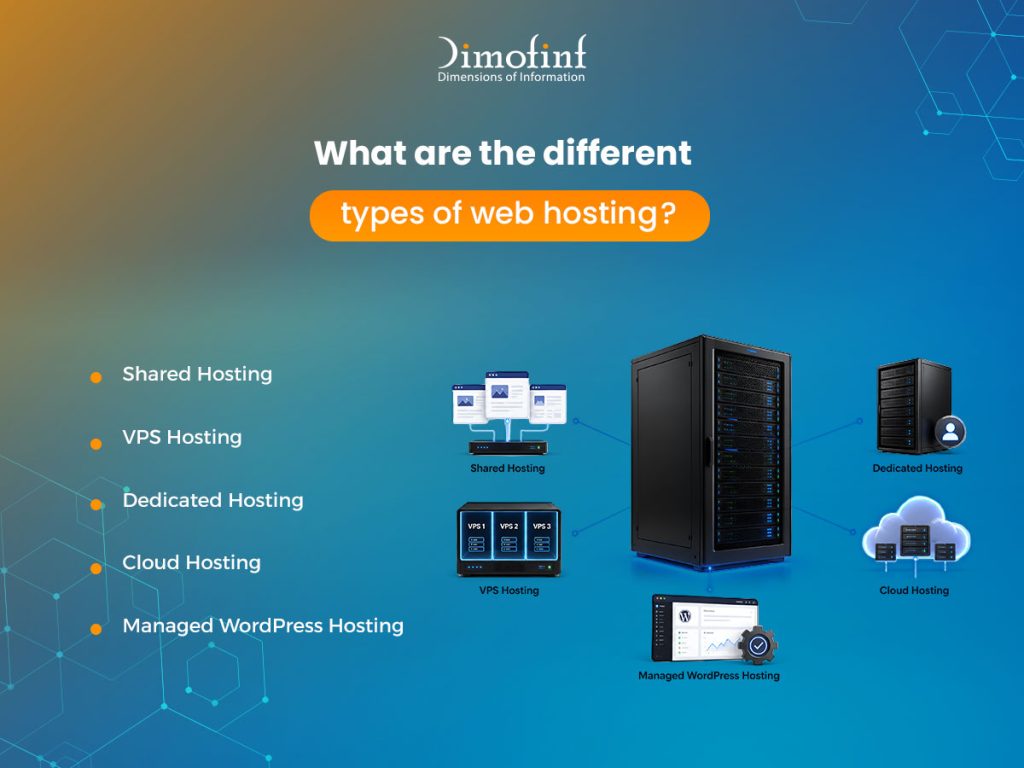
What are the different types of web hosting?
The answer of “what is internet hosting” is incomplete without telling the different types of web hosting. There are several varieties of hosting tailored to different needs:
Shared Hosting:
Shared hosting is the most affordable type of hosting. Multiple websites share the resources (RAM and CPU) of a single server. It is ideal for small blogs and personal websites with low traffic.
VPS Hosting:
The VPS shortcut refers to (Virtual Private Server). The physical server is divided into multiple virtual compartments. Each user has their own dedicated slice of resources, offering more stability and control than shared hosting without the cost of a dedicated server.
Dedicated Hosting:
In this type, the entire physical server is yours, you rent all its resources for your website alone. This provides maximum performance, security, and customization, making it the go-to choice for high-traffic enterprise sites or large e-commerce platforms.
Cloud Hosting:
Instead of one server, your site is hosted on a network of interconnected servers. If one server fails or experiences high traffic, another kicks in to maintain uptime. It is highly scalable and reliable.
Managed WordPress Hosting:
A specialized service optimized specifically for WordPress sites. It includes automated updates, enhanced security, and expert support, allowing site owners to focus solely on content.
For more details about the differences, take a look at the different hosting options we offer at Dimofinf.
Free vs paid web hosting
Choosing between free and paid web hosting involves a significant trade-off between immediate cost savings and long-term professional stability.
While free hosting saves money upfront, it often comes at a hidden cost. Providers may place forced advertisements on your site, limit your storage space, and offer no customer support
| Feature | Free web hosting | Paid web hosting |
| Monetization | Intrusive advertisements forced on your site | No forced ads; you control the monetization |
| Domain Name | Restricted to a subdomain (e.g., yoursite.host.com) | Professional custom domain (e.g., yoursite.com) |
| Support | No customer support for technical issues | 24/7 expert customer and technical support |
| Reliability | No uptime guarantees; frequent downtime | Service Level Agreements (SLA) for guaranteed uptime |
| Security | Minimal protection; user handles backups | Included SSL certificates and automated backups |
| Performance | Slow loading speeds due to overcrowded servers | High-speed performance with dedicated resources |
| Scalability | Strict resource ceilings; difficult to migrate | Easy upgrades to accommodate website growth |
.Conclusion
Answering “what is internet hosting” is just the beginning of your digital journey which starts with selecting the right hosting environment. While free hosting represents a good starting point for learning and experimentation, paid hosting stays the standard for anyone looking to build a professional presence, secure their data, and ensure their site is accessible to the world 24/7.
If you still have any questions about internet hosting, please don’t hesitate to contact us or visit Dimofinf website for further details.
Start your website today with fast and secure hosting at Dimofinf.
FAQs
Is web hosting the same as a domain?
Do I need hosting for a website?
Yes. Without hosting, your website files have no home on the internet.
What percentage of the internet is hosted on aws?
AWS currently powers approximately 31% to 33% of the global cloud infrastructure market.
How much does hosting cost?
The cost varies significantly based on the type of hosting. VPS hosting costs about $50 /month, shared hosting costs about $5 or $15 /month, managed WordPress hosting costs about $35 /month and dedicated servers cost up to $500 or more /month.
What our customers say
Share this article
What Are AI Domains? Uses, Benefits, and Examples
shared hosting vs vps hosting: Which one is better for your business?
How to Check SEO Ranking: Track Your Google Keyword Positions

7 Key Factors to Consider When Choosing a Google Ads Agency
What Are AI Domains? Uses, Benefits, and Examples
7 Key Factors to Consider When Choosing a Google Ads Agency
What Is Java? Features, Uses & How It Works

Website Design Company in Riyadh | Professional Web Design