
What Is Java? Features, Uses & How It Works
Java is one of the most popular programming languages in the world. It serves as the invisible engine running behind millions of mobile apps, web applications, and smart devices worldwide.
If you use a smartphone, check your bank balance online, or play popular games, you interact with Java every day. So, what is Java?
If you are planning to learn coding, launch a web application, or set up a multiplayer game server, this article will cover everything you need to know about Java in simple terms.
What is Java?
Java is a high-level, class-based, object-oriented programming language designed to run across multiple operating systems without requiring developers to rewrite the underlying code for each machine.
Sun Microsystems originally developed and released Java in 1995, and Oracle Corporation maintains and updates the platform today.
Today, Java serves as a foundational technology for enterprise backend systems, online banking engines, Android applications, cloud microservices, and high-volume data tools. Its strict security layers, automatic memory management, and extensive ecosystem of pre-built code packages make it one of the most reliable programming environments in global software engineering.
What is Java programming language used for?
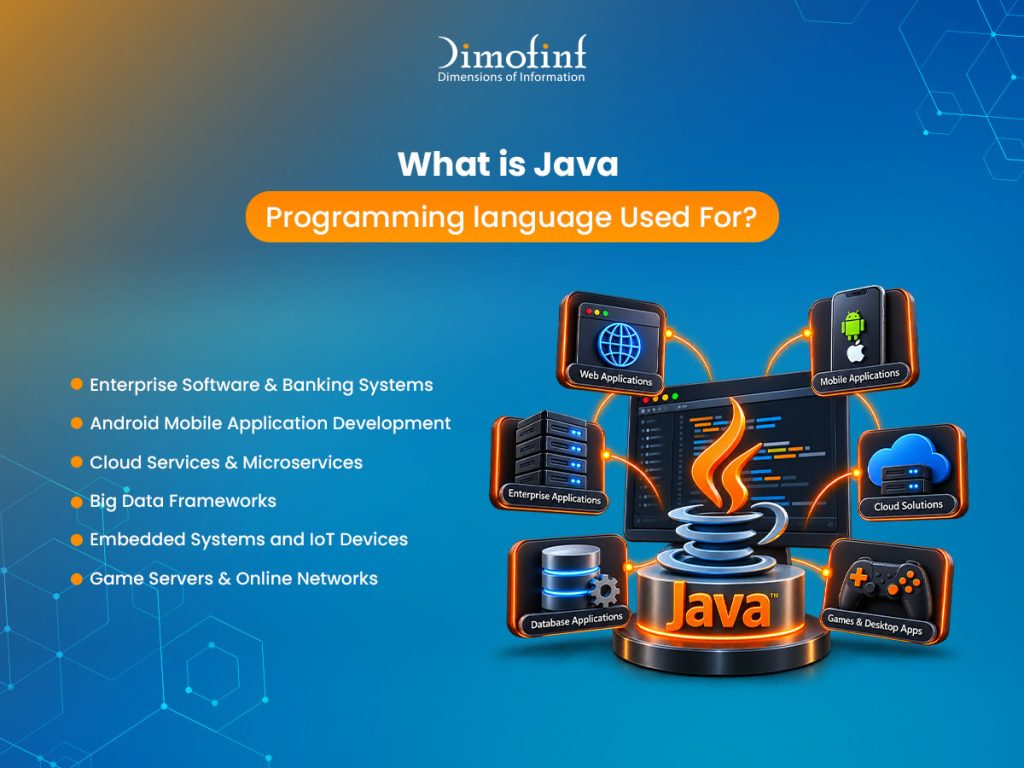
Java is used to build enterprise software, Android mobile applications, web backends, cloud microservices, big data processing systems, and embedded smart hardware.
Most developers and organizations choose Java when an application needs to process thousands of concurrent user requests safely and run reliably without crashing.
Here are the most famous applications of Java and how it is used across modern tech industries:
- Enterprise Software & Banking Systems: Financial institutions, insurance companies, and healthcare providers use Java backends to process high-volume transactions securely and keep customer records safe.
- Android Mobile Application Development: Although Kotlin is now popular for Android UI work, Java remains a core language for building native mobile applications and processing system-level smartphone tasks.
- Cloud Services & Microservices: Developers rely on Java frameworks like Spring Boot to construct lightweight microservices that scale effortlessly inside cloud server environments.
- Big Data Frameworks: Popular data processing tools like Apache Spark or Apache Hadoop rely on Java to analyze terabytes of unstructured information across distributed server networks.
- Embedded Systems and IoT Devices: Smart home appliances, connected car dashboards, industrial sensors, and medical equipment run Java runtime software because of its low memory overhead and predictable execution.
- Game Servers & Online Networks: Game studios use Java to power dedicated multiplayer servers, web portals, and custom game logic (most famously demonstrated in Minecraft: Java Edition).
What are the main features of Java?
Main features of Java are platform independence, object-oriented structure, memory management, security, multithreading, and a vast standard library.
These features make Java one of the most stable and scalable programming languages for enterprise development.
When we evaluate why Java remains a dominant force in modern software engineering, several core technical characteristics stand out:
- Platform Independence: Java code compiles into bytecode rather than specific machine instructions. This makes any computer equipped with a Java Virtual Machine execute this bytecode, allowing you to run the exact same program on Windows, Linux, or macOS without rewriting code.
- Object-Oriented Programming: Java structures software around real-world objects and data rather than isolated functions, making complex codebases easier to organize, reuse, test, and maintain over long development lifecycles.
- Automatic Memory Management: Java’s automated garbage collector continuously identifies unused objects in memory and removes them, drastically reducing memory leaks and system crashes.
- Built-in Security and Sandboxing: Java’s explicit type-checking, lack of direct pointer manipulation, and strict access controls prevent unauthorized code execution and memory corruption.
- Native Multithreading: Java allows programs to execute multiple threads or tasks concurrently, supporting multithreading and letting web servers and background processes handle thousands of simultaneous requests without lagging.
- Vast Standard API and Ecosystem: Java comes with thousands of pre-written libraries and packages for handling web protocols, database connections, file management, data structures, and cryptography right out of the box.
How does Java work?
Java works by compiling human-readable code into an intermediate format called bytecode, which executes inside a virtual runtime engine called the Java Virtual Machine (JVM). Instead of interacting directly with your operating system or device hardware, Java programs run inside the JVM, which acts as a universal translator on any device.
Here is a step-by-step process of how Java works and runs code from start to finish:
- Writing the source code: You write your program instructions in plain text files using a .java file extension. This source code contains the readable logic, variables, and methods you created.
- Compiling into bytecode: You run the Java compiler (javac) to process your source code. The compiler scans your file for syntax errors and translates your instructions into a binary format called bytecode, saved with a .class
- Loading the bytecode into memory: The Java Virtual Machine (JVM) loads your compiled .class files into system memory, then a subsystem called the ClassLoader gathers all required code libraries and dependencies so your program can run.
- Verifying security rules: Before running any instructions, the JVM’s Bytecode Verifier checks the code to verify that the file does not violate access rules, bypass safety barriers, or risk memory corruption.
- Translating and executing code: The JVM’s Execution Engine reads the bytecode instructions and translates them into machine code that your computer hardware understands. It uses an Interpreter to read code line by line and a Just-In-Time (JIT) Compiler to convert frequently repeated code blocks into fast native machine code.
- Managing runtime memory: As your program runs, the JVM handles RAM allocations automatically, creating memory space for active objects and continuously clears out unused data through background garbage collection.
What is Java in Minecraft?
Java in Minecraft is the original programming language used to build the entire game from scratch in 2009. Today, “Minecraft: Java Edition” refers to the classic PC, macOS, and Linux version of the game, distinguished by its open structure that allows players to install custom modifications, create personal game plugins, and run independent multiplayer servers.
While Mojang and Microsoft later created “Bedrock Edition” in C++ for cross-platform play across consoles and mobile devices, Java Edition remains the preferred version for developers, modders, and custom server administrators worldwide.
What is Java API?
The Java API is a comprehensive collection of standard libraries, packages, classes, interfaces, and methods that provide ready-to-use functionality for Java applications. This allows developers to handle common tasks like reading files, connecting to web servers and processing data collections without writing foundational code from scratch.
Instead of building fundamental systems manually, you can import pre-tested Java API libraries directly into your projects, saving time and keeping your code reliable.
Types of Java APIs:
- Core Language APIs: Essential tools that handle basic language building blocks, string operations, date formatting, and data collection structures like lists, maps, and queues.
- Input/Output and File APIs: Libraries designed for reading and writing data to files, handling system storage streams, and processing fast non-blocking disk operations, like java.io and java.nio
- Networking APIs: Components that manage socket connections, handle IP addresses, transmit HTTP requests, and interact with remote web servers, such as java.net and java.net.http
- Database Connectivity APIs: Standardized interfaces that let Java applications connect to relational databases, execute SQL queries, and retrieve database records, such as java.sql.
- Enterprise and Web APIs: Extended server-side libraries used for building enterprise microservices, RESTful web services, database persistence layers, and cloud infrastructure, such as Java EE.
- Graphical UI APIs: Visual component packages used to construct desktop applications with custom windows, clickable buttons, dialog menus, and graphics layout managers, like Swing, JavaFX.
What types of applications can be built with Java?
You can build web applications, enterprise portals, Android mobile apps, cloud microservices, big data processing systems, desktop software, embedded smart devices, and game servers using Java.
Web Applications and Portals:
Large organizations build web backends, customer portals, and internal management platforms using Java web frameworks such as Spring Boot, Jakarta EE (formerly Java EE), and Quarkus. These applications connect safely to large databases and process high numbers of simultaneous user sessions.
Native Android Mobile Applications:
Developers use Java within Android Studio to build mobile applications, background synchronization services, and system tools. While developers often use Kotlin for user interface design today, Java code forms the foundation of millions of published Android apps and Android OS framework services.
Cloud-Native Microservices and REST APIs:
Software engineers use Java to build modular microservices that run inside Docker containers and Kubernetes clusters. Frameworks like Spring Boot allow developers to create lightweight HTTP APIs that scale up or down automatically based on server traffic.
Desktop Graphical User Interface (GUI) Software:
Developers construct cross-platform desktop programs using graphical libraries like JavaFX and Swing. Popular developer applications, including the IntelliJ IDEA code editor and NetBeans, run directly as Java desktop programs across Windows, macOS, and Linux.
Multiplayer Game Servers and Network Services:
Game studios build backend matchmakers, player database services, and dedicated multiplayer game servers in Java. The most prominent example is Minecraft: Java Edition, where thousands of independent game networks run custom server software built entirely on Java.
What are the main concepts of Java programming?
The main concepts of Java programming center around Object-Oriented Programming (OOP) principles like: classes and objects, encapsulation, inheritance, polymorphism, and abstraction.
These core pillars allow developers to structure software as modular, reusable components that reflect real-world behaviors and data models.
If you mastered these concepts while learning Java, you would be able to write clean code architecture and manage complex application logic efficiently.
Classes and Objects:
A class acts as a blueprint or template that defines properties (variables) and actions (methods). An object is an actual instance created from that class blueprint.
For example, a Car class defines general traits like color and speed, while a specific myCar object holds actual values like “Red” and “120 mph”.
Encapsulation:
Encapsulation wraps data and methods inside a single class while restricting direct external access to object internals. Keeping variables private and providing access through public getter and setter methods will protect data integrity and prevent unauthorized code modifications.
Inheritance:
This allows you to add a new class, subclass or child to inherit properties and methods from an existing class. This mechanism eliminates redundant code duplication and creates a logical hierarchy across complex software components.
Polymorphism:
Polymorphism—meaning “many forms”—enables a single method or interface to behave differently depending on the object invoking it. Java achieves polymorphism through method overloading and method overriding (redefining a parent class method in a child class).
Abstraction:
Abstraction hides complex background logic and reveals only essential functional interfaces to the user. By utilizing abstract classes and interfaces, Java allows you to define what a program module does without forcing callers to manage how it handles internal calculations.
What are the advantages and disadvantages of Java?
The main advantages of Java include platform independence, strong security, automatic garbage collection, and a massive open-source ecosystem, while its main disadvantages are slower execution speed compared to compiled languages like C++, higher memory consumption, and verbose syntax.
Advantages of Java:
- Cross-Platform Portability: Java allows code compiled on one operating system to run seamlessly on any machine equipped with a Java Virtual Machine without modification.
- Automatic Memory Management: The Java Virtual Machine continuously manages RAM allocation and runs background garbage collection to remove unreferenced objects, dramatically reducing memory leaks and pointer crashes.
- Robust Built-in Security: Java’s ability to operate inside a sandboxed execution environment can restrict access, enforce explicit type checking, and prevent direct memory access, protecting applications from malicious execution and system corruption.
- Vast Enterprise Ecosystem: Decades of active community development mean you have access to millions of pre-built packages, battle-tested frameworks like Spring, and industrial-grade development tools.
- Native Multithreading: Built-in multithreading capabilities allow Java programs to process multiple tasks and user connections simultaneously, making it ideal for high-concurrency web services.
Disadvantages of Java:
- Slower Execution Speed Than Native Languages: Raw computational performance is slower than natively compiled C or C++ binaries, because Java relies on intermediate bytecode and JVM interpretation.
- Higher Memory Footprint: Running the Java Virtual Machine alongside background garbage collection routines requires significantly more system memory than lightweight compiled languages.
- Verbose Syntax and Code Volume: Java requires developers to write longer, highly explicit code blocks to handle simple tasks compared to concise modern languages like Python or Go.
- Complex Runtime Configuration: Managing server-side Java deployments—such as tuning JVM heap memory, configuring garbage collector settings, and setting up application servers like Tomcat—requires specialized system administration.
What are the best tools for Java development?
The best tools for Java development include: IntelliJ IDEA and Eclipse for writing code, Apache Maven for building automation tools, Gradle for dependency management, and Apache Tomcat and WildFly for running web applications.
| Tool Name | Features | Best Used For |
| IntelliJ IDEA | Advanced code completion, deep static analysis, robust refactoring tools, and built-in database management. | Enterprise Java applications, Spring Boot microservices, and professional software engineering. |
| Eclipse | Open-source foundation, highly extensible plugin ecosystem, lightweight footprint, and flexible customization. | Open-source software projects, academic learning, and custom tool building. |
| Apache NetBeans | Out-of-the-box support for Java EE, built-in Swing GUI designer, simple project wizards, and modular architecture. | Desktop GUI development, beginner projects, and rapid prototyping. |
| Apache Maven | Declarative XML configuration (pom.xml), standardized directory structures, and centralized dependency resolution. | Standard enterprise applications and teams needing strict build consistency. |
| Gradle | Domain-specific scripting (Groovy/Kotlin DSL), incremental build caching, high execution speed, and custom build pipelines. | Complex multi-module applications, Android development, and modern Spring Boot projects. |
| Apache Tomcat | Lightweight web server executing Java Servlets and Jakarta Server Pages (JSP) with minimal resource overhead. | Hosting Java web backends, REST APIs, and containerized Spring Boot services. |
| WildFly (JBoss) | Full Jakarta EE application server offering enterprise scalability, modular subsystem management, and fast startup times. | Large-scale enterprise applications requiring full EE specifications and Enterprise JavaBeans (EJB). |
| OpenJDK / Eclipse Temurin | Free, open-source distribution of the Java SE platform backed by active community security updates and long-term support (LTS). | Production deployments, cloud Docker containers, and enterprise server hosting. |
Conclusion
Over three decades after its initial release, Java remains one of the most practical, secure, and widely adopted programming languages in modern software engineering. Its core principle of “Write Once, Run Anywhere” (WORA), combined with automatic garbage collection, strict type safety, and a massive open-source ecosystem, makes it an ideal framework for building scalable enterprise applications.
What our customers say
Share this article

Website Design Company in Riyadh | Professional Web Design

Cheapest Website Hosting: Compare the Best Affordable Hosts
What Is a Minecraft Server? How It Works & Server Types

How to Check SEO Ranking: Track Your Google Keyword Positions
Website Design Company in Riyadh | Professional Web Design
Cheapest Website Hosting: Compare the Best Affordable Hosts
What Is a Minecraft Server? How It Works & Server Types
How to Check SEO Ranking: Track Your Google Keyword Positions