
Marketing Strategy: How to Build a Successful Growth Plan
Running a business without a clear strategy is like driving in the dark without headlights. You might move forward, but you are bound to crash. Too many companies waste thousands of dollars on random ads, thinking it’s enough to gain clients, but in the long term, they will suffer.
That is where a marketing strategy comes in. It defines exactly who your customers are, where they hang out, and how to get them to buy.
Stop the guesswork and start growing your business with these five simple steps to build your first strategy.
What is an effective marketing strategy?
An effective marketing strategy is a business’s long-term, comprehensive plan designed to reach target prospects and convert them into loyal, paying customers. It acts like the operational blueprint that coordinates your product, its pricing, where you sell it, and how you promote it to achieve a sustainable competitive advantage in your industry.
When we talk about a strategy being effective, we mean that it connects your overall business goals with your daily sales activities. It is not just a single social media campaign or a monthly email newsletter. Instead, it is the underlying logic that guides all those individual efforts. It tells you why you are choosing certain channels over others, what your brand sounds like to the public, and how you solve a specific problem for your audience better than your competitor.
Why does every business need a marketing strategy?
Every business needs a marketing strategy because it prevents financial waste, aligns your team’s daily efforts, and ensures your products reach the exact people who are most likely to buy them. Without this strategic blueprint, you are essentially relying on luck to grow your brand, which is a dangerous way to run a company.
Here is exactly how a solid strategy solves the most common business growth problems:
- It stops the ad-hoc marketing trap: Many companies run a Facebook ad this week, print flyers next week, and hire an influencer the week after. These actions are completely disconnected and rarely produce lasting results. A strategy ensures every campaign works together toward a single goal.
- It acts as a filter for business decisions: When a new social media platform or marketing trend pops up, you can look at your strategy to decide if your target audience is actually there. If they are not, you save your time and money.
- It builds consistency across your entire business: When everyone in your team understands the core strategy, your brand speaks with one unified voice. This consistency builds deep trust, and people prefer to buy from brands that feel stable, professional, and clear.
- It turns expenses into engines: A marketing strategy transforms your marketing department from a confusing business expense into a predictable, data-driven engine that consistently generates sales and protects your market share.
How do I identify my target audience?
Identifying your target audience means pinpointing the specific group of consumers most likely to purchase your product or service based on their shared demographics, online behaviors, and pain points. You cannot sell to everyone, and trying to do so is the fastest way to drain your marketing budget with zero return on investment.
How can I build an effective marketing strategy?
To build an effective marketing strategy you need a structured, step-by-step approach that connects your business goals with the daily reality of your market. Here are five steps to build your first marketing strategy and create a system that consistently generates leads and sales:
1.Establish clear, measurable business goals:
Before you spend a single dollar on marketing, you must define exactly what you want to achieve. We recommend setting objectives that are highly specific and tied to a realistic timeline, such as increasing online store sales by 25% over the next six months. If your goals are too vague, like “increasing brand awareness,” you will never know if your campaigns are truly profitable or just burning your budget.
2.Audit your current market position and assets:
You must take an honest look at where your business stands in relation to the wider market. We do this by analyzing your unique strengths, weaknesses, external opportunities, and competitive threats. Take inventory of the assets you already own, such as an established email list, a fast-loading website, or high organic reach on social media, so you know exactly which building blocks you have to work with.
3.Select the right marketing channels for your message:
Do not make the mistake of trying to establish a presence on every single marketing platform at once, as you will quickly exhaust your resources. Instead, pick two or three key channels where your target audience spends most of their time online. If you are selling consulting services to other businesses, we suggest focusing on search engine optimization and direct email outreach rather than trying to build a viral consumer brand on TikTok.
4.Define your marketing budget and tracking metrics:
You must decide how much money you can afford to invest in growth and how you will measure your return on investment. Assign clear key performance indicators to each channel you choose. If you are running paid search ads, you must track your cost per acquisition to ensure your spending remains sustainable and directly contributes to your bottom line.
5.Launch your campaigns, analyze the data, and optimize:
A marketing strategy is not a static document that you write once and file away in a drawer. Once you launch your campaigns, you must review the performance metrics after a few weeks to see what the data tells you. We treat marketing as a continuous cycle where you constantly double down on the channels that work and quickly pause or tweak the tactics that do not deliver.
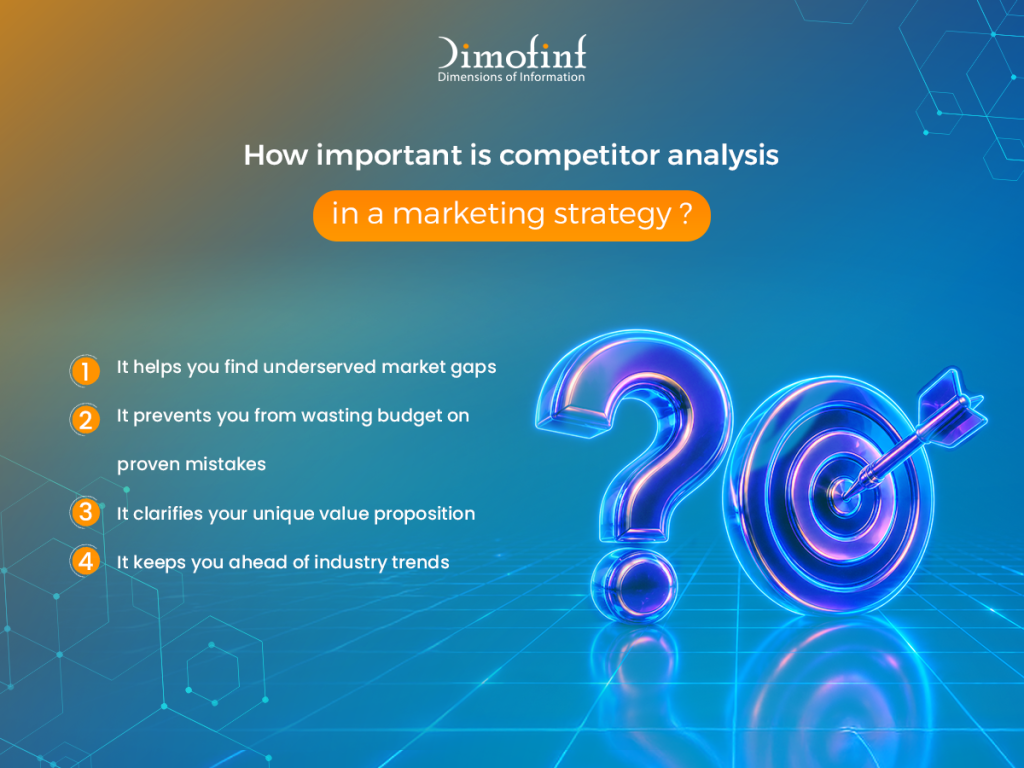
How important is competitor analysis in a marketing strategy?
Competitor analysis is important to your marketing strategy because it reveals exactly where the market is overserved and where gaps exist for you to exploit. You do not look at competitors to copy them; you look at them to figure out how to differentiate your business. If you skip this step, you risk launching a brand that sounds exactly like everyone else, which makes it incredibly difficult to win market share.
Here is why competitor analysis is so valuable for your growth:
- It helps you find underserved market gaps: By looking closely at your competitors’ customer complaints, negative reviews, and product limitations, you can identify unmet customer needs.
- It prevents you from wasting budget on proven mistakes: Your competitors have likely spent thousands of dollars testing different marketing channels, ad copy, and offers. By auditing their social media feeds, search engine rankings, and ad histories, you can see what they have abandoned and what they continue to invest in.
- It clarifies your unique value proposition: You cannot explain why your product is the best option unless you know what other options your customers have. Competitor analysis shows you what prices they charge, what features they highlight, and what promises they make, so you can craft a message that stands out.
- It keeps you ahead of industry trends: Markets are not static. When a major competitor shifts their strategy, changes their pricing, or launches a new product line, it can alter customer expectations. Regular analysis ensures you are never blindsided by changes in the industry.
What is the difference between a marketing plan and a marketing strategy?
The difference between a marketing strategy and a marketing plan is that a marketing strategy defines your long-term business goals, who your target audience is, and the core message you want to deliver to the world. While a marketing plan defines the practical, step-by-step roadmap that outlines the specific campaigns, budgets, and timelines you will use to achieve the goals set by your strategy.
To make this distinction as clear as possible for you, we have broken down the primary differences in the comparison table below:
| Feature | Marketing Strategy | Marketing Plan |
| Core Focus | Defines long-term goals, target audience, and brand positioning. | Outlines specific actions, marketing channels, and campaign timelines. |
| Time Horizon | Long-term (typically looking three to five years into the future). | Short-term (typically focused on the next quarter or the current year). |
| Flexibility | Highly stable; changes only if the business model changes. | Highly flexible; constantly updated based on campaign data. |
| Key Deliverables | Buyer personas, unique value propositions, and market positioning maps. | Editorial calendars, budget spreadsheets, and specific task assignments. |
| Success Metric | Overall market share, brand equity, and customer lifetime value. | Click-through rates, lead generation numbers, and cost-per-click averages. |
Conclusion
At the end of the day, even the most brilliant marketing strategy is only as powerful as its execution. You can have a perfect plan on paper, but without consistent optimization, deep audience insights, and a dedicated team that knows how to turn data into revenue, your growth will stall. True business growth requires taking that strategic vision and executing it with flawless, daily precision.
That is where we come in. At Dimofinf, we partner with you to scale your business from the ground up, taking the tactical weight off your shoulders, and transform your strategic goals into high-converting campaigns. From SEO and content marketing to targeted social media ads, we handle the technical execution so you can focus on running your business.
Stop guessing now and start growing with a data-driven strategy. Contact Dimofinf’s marketing experts today to build a tailored strategy that takes your brand to the next level.
FAQs
ما هي أفضل شركة إستضافة مواقع في السعودية؟
هل توفر الاستضافة شهادة SSL مجانية؟
كيف تؤثر الاستضافة على ترتيب الموقع في جوجل؟
What our customers say
Share this article

Website Design Company in Riyadh | Professional Web Design
Cheapest Website Hosting: Compare the Best Affordable Hosts

What Is a Minecraft Server? How It Works & Server Types
How to Check SEO Ranking: Track Your Google Keyword Positions

Generative Engine Optimization Tools: Best GEO Tools for AI Search
What Is Affiliate Marketing and How Does It Work?
How to find the best SEO company in Saudi Arabia in 2026?
SEO for Automotive Industry | Boost Car Dealer & Auto Service Rankings