
How Artificial Intelligence Is Transforming Cyber Security
Every second, hackers do their best to find new ways to slip past your defenses, lock down your data, or steal your customers’ private info. If you are still relying on old, manual setups to keep them out, you are playing a losing game. The threats are simply moving too fast for human eyes to catch.
That is where artificial intelligence comes in. It acts like a digital guard that never blinks, catching and stopping attacks before they can do any damage.
Let’s explore how artificial intelligence in cyber security protects your business from modern cyber threats.
What is artificial intelligence in cyber security?
Artificial intelligence in cyber security is the deployment of machine learning algorithms, deep learning models, and behavioral analytics to automate threat detection, identify patterns of compromise, and initiate defensive actions in real-time. Instead of relying on human analysts to manually review logs after a breach has occurred, this technology analyzes massive streams of network data instantly to stop active exploits.
When we deploy AI on a network, the first thing it does is establish a baseline of normal behavior. It studies how your employees log in, what time of day they access files, where they are connecting from, and how data typically moves across your servers. Once the system understands what a normal day looks like, it can spot anomalies instantly.
For example, if an employee account suddenly logs in from a new country at 3:00 AM and starts copying thousands of private customer records, the AI doesn’t wait for a security team to notice. It recognizes that this behavior contradicts the established pattern, flags the account, and automatically locks down the connection in seconds.
How is AI used in cyber security?
We use artificial intelligence in cyber security to perform three critical tasks: monitoring user behavior, analyzing email text for hidden threats, and scanning code for software vulnerabilities.
By processing millions of data points simultaneously, AI tools execute these tasks in milliseconds, providing a level of speed and scale that no human security team can match.
If you want to understand how this works in your day-to-day business operations, we must look at the specific technologies driving modern digital defense:
1. User and Entity Behavior Analytics
Traditional systems only look at whether a user enters the correct password, but
AI models track what files you normally open, how fast you type, what links you click, and what devices you use.
If a hacker steals your password, they cannot steal your behavioral footprint. The moment the system detects that the logged-in account is navigating your database in an unusual way, it raises an alarm and locks the session, even if the password was entered correctly.
2. Natural Language Processing (NLP) for Phishing Detection
AI uses Natural Language Processing to read and understand the actual context, tone, and intent of incoming emails. The AI can detect subtle signs of social engineering.
For example, if an email claims to be from your CEO demanding an urgent wire transfer but uses a slightly different writing style or structure, the AI flags it as suspicious before it ever reaches your inbox.
3. Automated Vulnerability Management
Instead of waiting for a manual security audit, AI-driven scanners run 24/7 in the background of your servers, actively analyzing your entire software stack for outdated code, misconfigurations, or open ports.
When the system finds a vulnerability, it can automatically download, test, and deploy the necessary security patch in a virtual sandbox, securing your system without causing any downtime.
Can AI detect cyber threats automatically?
Yes, artificial intelligence can detect cyber threats automatically. By continuously analyzing network traffic, system logs, and user behavior, AI models identify anomalies and flag potential exploits in real-time. This automated detection happens in milliseconds, allowing systems to isolate infected devices, block malicious IP addresses, and quarantine threats before human security teams even realize an attack is underway.
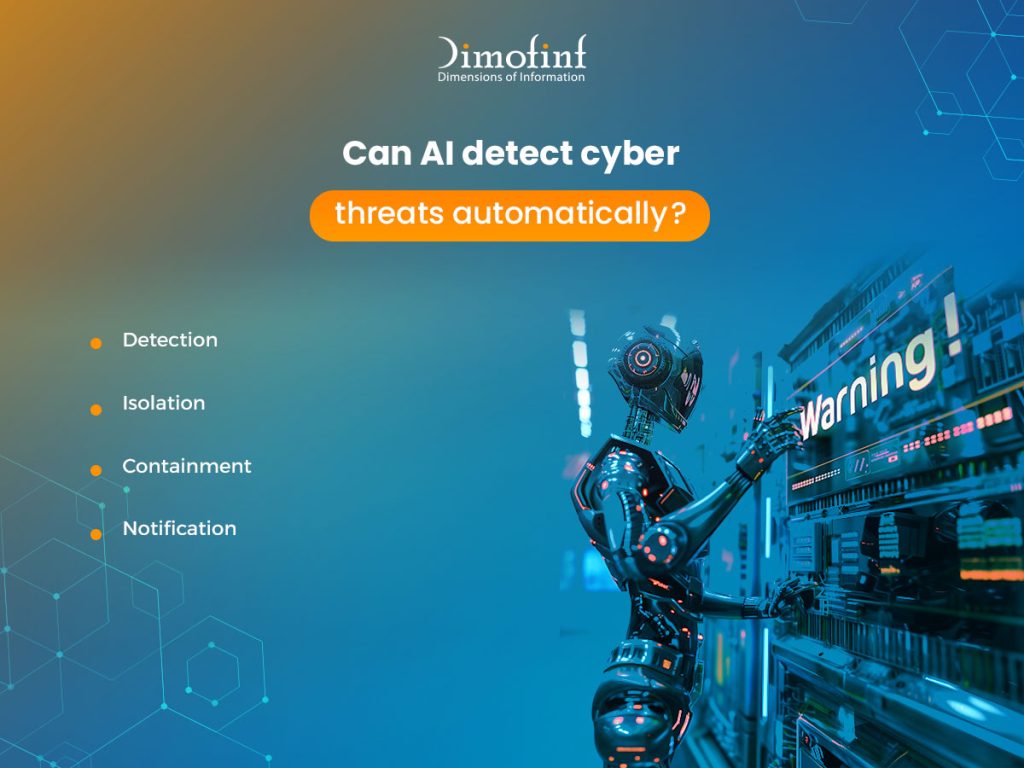
Here is how AI can detect threats in cyber security:
- Detection: The AI identifies that an employee’s account has suddenly logged in from an unrecognized location and is attempting to download database backups.
- Isolation: Within milliseconds, the AI automatically terminates the active session and locks the user account.
- Containment: If the account has already downloaded a malicious file onto a local computer, the AI isolates that specific device from the rest of your company’s network, preventing the threat from spreading sideways (lateral movement).
- Notification: Only after the threat is contained does the system send an alert to your IT manager, detailing exactly what happened and why the lockdown took place.
How can AI help prevent cyberattacks?
Artificial intelligence can prevent cyberattacks by shifting your digital defense from a reactive posture (responding after a breach occurs) to a proactive posture (stopping threats before they ever breach your perimeter).
By continuously scanning network configurations, analyzing global threat feeds, and running automated penetration tests, AI identifies and patches vulnerabilities before hackers can exploit them.
Here is a breakdown of how AI can help in preventing cyberattacks and secure your digital operations:
- AI scans the global web, dark web forums, and shared threat databases 24/7 to learn about newly discovered vulnerabilities and emerging malware strains.
- The moment a new exploit is discovered anywhere in the world, AI automatically updates your firewall rules and security protocols to block that specific threat pattern, shielding your business before the hackers even look your way.
- Natural Language Processing (NLP) models read incoming emails in real-time, analyzing behavioral patterns, links, domain reputations, and semantic context. If an email shows signs of social engineering, the AI intercepts it, quarantines it and neutralizes the attack at its most common entry point.
What are the benefits of AI in cyber security?
The benefits of artificial intelligence in cyber security are its ability to analyze billions of data points simultaneously, reduce threat response times to milliseconds, and eliminate human error in routing alerts. By automating repetitive auditing tasks, AI allows security teams to focus on strategic defense rather than sorting through false alarms.
Here is a detailed look at the core benefits of artificial intelligence in cyber security:
- AI keeps data completely protected even when your office doors are locked and your IT team is offline.
- AI automatically filters out up to 80% of safe, routine anomalies. This ensures your IT team only spends their valuable time investigating real, high-priority threats.
- AI can detect complex threats in milliseconds, stopping hackers before they can download a single file.
- AI strengthens your vulnerability management processes with more accurate system assessments, supports faster issue resolution, and improves decision-making.
- AI can also identify weaknesses across your networks and systems, allowing security teams to prioritize the most critical risks and focus their efforts on high-impact security measures.
Traditional Cybersecurity vs AI-Enhanced Cybersecurity
The difference between traditional cybersecurity and AI-enhanced cybersecurity lies in their approach to threat detection, while traditional security relies on a reactive, signature-based model (matching files against a list of known threats), AI-enhanced security uses a proactive, behavioral-based model (analyzing patterns to predict and stop unknown threats in real-time). This shift in methodology reduces your response latency from hours or days to milliseconds.
This table outlines the technical differences that define how each model protects your corporate assets:
| Feature | Traditional Cybersecurity | AI-Enhanced Cybersecurity |
| Detection Method | Signature-matching and rigid rules | Behavioral anomalies and heuristics |
| Zero-Day Protection | Zero protection; Limited protection against unknown threats; requires signature updates. | Highly effective; detects malicious behavior instantly |
| Response Latency | Manual intervention. | Automated mitigation |
| Scale of Analysis | Limited to sequential, human-triggered audits. | Massively parallel; processes millions of events per second |
| Operational Effort | High; requires manual rule tuning and alert sorting. | Low; automates routine audits and filters out 80% of noise. |
Conclusion
The threat landscape in 2026 leaves no room for hesitation. Cybercriminals do not negotiate, and they certainly do not wait for your IT team to manually patch a security gap. Implementing artificial intelligence in cyber security is the only way to match the speed, scale, and sophistication of modern hackers. However, as we have outlined, even the most advanced AI security tools are only as fast as the servers they run on. If your business operations are hosted on slow, distant overseas servers, the network lag will delay your automated defenses, turning a millisecond threat mitigation into an hours-long disaster.
At Dimofinf, we remove this latency bottleneck by hosting your corporate databases, websites, and applications on high-performance Saudi-based cloud infrastructure. Powered by enterprise-grade NVMe SSDs, our local servers drop network latency to under 50 ms. This ensures your AI security systems have the raw processing speeds and local telemetry pathways they need to predict, detect, and isolate threats in real-time, protecting your digital assets without compromising your daily operational performance.
Do not wait for a breach to upgrade your digital defense. Protect your enterprise with Dimofinf’s high-speed, secure Saudi cloud hosting today and keep your business safe around the clock.