
SEO for Automotive Industry | Boost Car Dealer & Auto Service Rankings
Your showroom is quiet, even though your lot is packed with inventory. You’re likely spending a fortune on digital ads, generating leads that never show up for a test drive.
This is where SEO for automotive comes in. It isn’t just about visibility; it’s about being the answer when a customer asks Google for their next vehicle.
It’s time to stop chasing random clicks and start owning the search results that actually put keys in hands.
What is Automotive SEO?
Automotive SEO is a very specific set of techniques designed to help your dealership or car business show up when a buyer searches for a car or nearby dealerships.
It is not just about general ranking on Google. Instead, we focus on making sure your specific inventory and services appear right in front of people who are ready to book a test drive or trade in their current vehicle.
In our experience, SEO for automotive isn’t just a task, it is a continuous process of updating your stock, responding to local feedback, and keeping your technical infrastructure fast. When we get this right, your website stops being a static brochure and starts acting like your most productive salesperson.
Why is SEO important for car dealerships and automotive businesses?
SEO is important for car dealerships and automotive business today because search engines has replaced the physical showroom as the primary destination for modern car buyers. It’s faster and easier for customers than visiting the showroom. Besides that, SEO for automotive business generates high quality leads that have high intent to buy a car.
SEO is the best tool to be the market leader in your area and here is why it is no longer optional:
Sustainable Alternative to digital ads burn
Many dealerships rely heavily on Pay-Per-Click ads. While effective for immediate traffic, the moment you stop paying, the leads vanish. Automotive SEO is a long – term investment. By building organic rankings, you create a self-sustaining source of traffic that doesn’t require a dollar-for-dollar spend every time someone clicks on your inventory. Over time, the cost per lead from SEO is significantly lower than any paid channel.
Capturing the “Zero Moment of Truth”
In marketing, the Zero Moment of Truth refers to the research phase of the buying process. It is the exact moment a customer identifies his need or interest and turns to Google to learn more before making the final decision.
Buying a car is a high-consideration purchase. Customers spend weeks searching for “best family SUVs” or “dealerships with 0% financing”.
SEO for automotive allows you to appear at every stage of this funnel when you provide the answers to their questions through your content. You build a relationship with the buyer long before they ever step onto your lot.
Building trust and brand authority
Most users subconsciously view the top organic result as the authority in the market, while sponsored ads are often viewed as commercial noise for them. Ranking highly for competitive automotive keywords signals to the buyer that your business is established, reputable, and trusted by the search engine itself.
Earning the local dominance
Automotive sales are inherently local. When a user searches for “used trucks in [City Name],” Google uses local SEO signals to determine who to show in the map. Without an optimized local SEO strategy, you are essentially handing those customers to the competitor down the street who has claimed their digital territory.
Mobile-driven conversions
SEO for automotive ensures your site is technically sound and fast enough to capture that mobile traffic, turning a quick search into a scheduled test drive.
How can SEO help increase car sales online?
SEO can increase car sales by attracting the right visitors at the exact moment they are ready to move from a browsing to buying phase, where the sales cycle is long and the price point is high.
Here is how a strategic SEO for automotive can impact on your car sales:
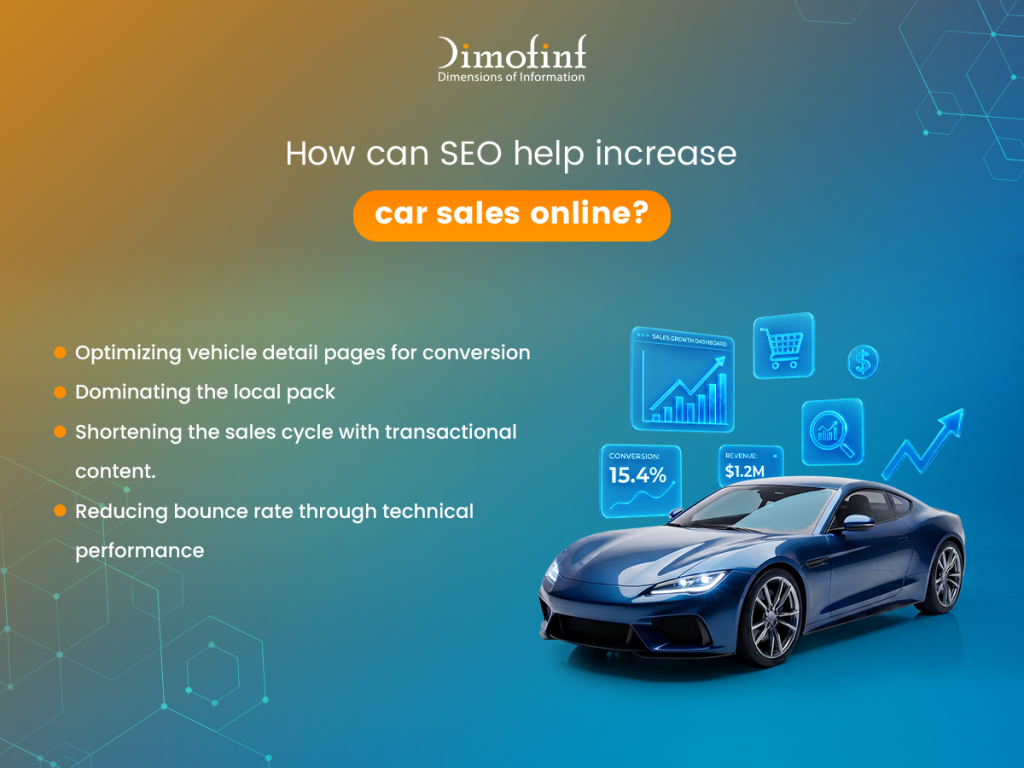
Optimizing vehicle detail pages for conversion
SEO turns your vehicle detail pages into high-converting landing pages by:
- Long-Tail Keyword Targeting: Instead of just “Used Camry,” we optimize for “Used 2022 Toyota Camry for sale in [City].” This captures users with high intent to buy.
- Rich Results: By using “Product Schema,” we can make your specific cars display pricing and availability directly in the Google search results, increasing the click-through rate (CTR) from ready-to-buy customers.
Dominating the local pack
Car purchasing is inherently a local business. When a user searches for “Best car deals near me” or “Car dealership in [City],” Google displays the Map Pack.
A specialized SEO for automotive ensures your Google Business Profile is fully optimized, showing your latest reviews, store hours, and high-quality photos of your lot.
Shortening the sales cycle with transactional content
Buying a car is a high-friction process filled with anxiety about financing, trade-ins, and reliability. SEO allows you to eliminate these buying barriers.
When a customer finds content that explicitly proves your value over a competitor, they are much more likely to fill out a lead form or book a test drive through your site.
Reducing bounce rate through technical performance
In the digital world, speed equals sales. If a potential buyer is trying to view a high-resolution gallery of a luxury car and the page takes five seconds to load, they will leave.
SEO for automotive focuses on Core Web Vitals. By ensuring your site is fast and mobile-responsive (especially through high-performance hosting like Dimofinf), you prevent lead leakage and keep the buyer engaged with your inventory.
How to use video SEO for automotive marketing?
To use video SEO for automotive marketing effectively and turn your vehicle inventory into searchable digital assets, follow these steps to optimize your video content for both Google and YouTube:
- Perform Intent-Based Keyword Research: Identify terms your buyers are actually searching for, such as ” Model interior tour” , or “best SUVs for families in [City]” . Focus on long-tail keywords that signal high purchase intent.
- Optimize Titles and Descriptions for Local Reach: Include the year, make, model, and your location in the first 60 characters of your title. In the description, provide a detailed summary of the vehicle’s features and include a direct link to the Vehicle Detail Page (VDP) on your website.
- Utilize Key Moments: Add timestamps to your video descriptions (e.g., 0:45 – Engine Specs, 1:20 – Infotainment System). This allows Google to display specific segments of your video directly in the search results, helping users find the exact information they need.
- Embed for Retention and Site Speed: Host your videos on a fast, responsive player (leveraging Dimofinf’s high-performance hosting) and embed them directly onto your inventory pages. High-quality video keeps users on your page longer, which is a powerful signal to Google that your content is valuable.
- Include a clear “next step” as a CTA: At the end of the video and in the description, tell the viewer exactly what to do next. Use phrases like “Book your test drive today” or “View our full [Brand] inventory here.”
How does AI impact automotive SEO?
AI now is the engine that drives Google’s search algorithms. For automotive SEO, this means the focus is shifting from ranking for keywords to providing high-quality data that AI models can interpret and recommend.
Here is how AI can impact automotive SEO:
AI Overviews and the Search Generative Experience (SGE)
Google’s AI-powered snapshots now answer complex car-buying questions directly on the search results page. AI doesn’t just show links; it synthesizes a list based on reviews, specs, and local availability.
Your website needs to be the source of that data to win the AI overview by making your content structured clearly, using data points that AI can easily extract.
The Visual Search
AI models are now incredibly proficient at identifying vehicle models, trims, and even colors from images. Through tools like Google Lens, a buyer can see a car on the street, take a photo, and find a local dealership that has it in stock.
By optimizing your high resolution images and ensuring your site is hosted on a high-performance server like Dimofinf’s (to ensure those large images load instantly), you make it easier for AI to recognize your inventory as the correct match for a visual search.
Intent Matching
AI Search is becoming more conversational and more focused on the intent behind the words. This means your content should sound human and answer specific questions.
Review Summarization and Sentiment Analysis
AI now can read any business’s reviews across the web to determine its reputation. Besides looking at the star rating, it looks at reviews.
By optimizing your local reputation, you will gain high-quality customer feedback, which is a direct signal to the AI that your dealership is a trustworthy answer to a buyer’s query.
How to do keyword research for your car dealership?
To do a keyword search for your car dealership, follow this checklist to transform your list of words into a high-converting digital sales engine:
- Generate transactional keywords by identifying your top performing keywords and create variations like “Buy 2026 Toyota Land Cruiser in Riyadh”.
- Target lifestyle and utility long-tail phrases by identifying the needs behind a specific car.
- Claim your near me local intent by auditing your keywords to include hyper-local identifiers. Use phrases that include “near me” to ensure you appear when local buyers are on the move.
- Use Google’s “People Also Ask” to find common buyer anxieties and create content around these questions to capture traffic from your competitors.
- Sync strategy with technical SEO performance. Keywords are useless if the page doesn’t load fast. High-intent buyers will turn back to Google if your media-heavy inventory pages lag.
Conclusion
After we covered a lot of technical explanations about SEO for automotive, here is a little fact: even the most brilliant SEO strategy needs a powerful engine to run on. Keyword lists and video walkthroughs are only effective if your website is fast, secure, and built to convert. That is where we come in.
At Dimofinf, we build digital showrooms designed for dominance. Whether you need a high-performance hosting environment that handles media-heavy inventory pages with ease, or a data-driven SEO strategy that puts your dealership in the “Local Map Pack,” our team is ready to help you outpace the competition.
Start today and explore Dimofinf’s specialized SEO for automotive & web development Services for dealerships.
What our customers say
Share this article
Website Design Company in Riyadh | Professional Web Design

Cheapest Website Hosting: Compare the Best Affordable Hosts

What Is a Minecraft Server? How It Works & Server Types
How to Check SEO Ranking: Track Your Google Keyword Positions
Generative Engine Optimization Tools: Best GEO Tools for AI Search

What Is Affiliate Marketing and How Does It Work?
Marketing Strategy: How to Build a Successful Growth Plan
How to find the best SEO company in Saudi Arabia in 2026?