What is Digital Advertising? Benefits, Types & How It Works
How many times have you seen an ad for the product you just searched for? That is the magic of digital advertising.
Unlike the static billboard, digital advertising is a mobile billboard promoting your business through search engines, social media, and websites, following your ideal customers wherever they go online. It is all about getting the right message to the right person at the right time.
Today, we will talk about what is digital advertising, its main types and how to use it right to get the best results for your business.
What is digital advertising?
Digital advertising is a marketing method to promote your services or products through different online platforms where most of the audience spend their time while they are busy doing something else online.
Simply, digital advertising is about the space you buy on the screen to show your products or services.
In real-world usage, this means you are paying to appear in a person’s path. You might pay for a spot at the top of a search results page. You might pay to show a video before someone watches a clip on YouTube. Sometimes, you pay for a small banner on a news website or a sponsored post in a social media feed.
Here is what makes this work for you:
- You reach people based on their specific interests or what they just typed into a search bar.
- You can see exactly how many people clicked your ad and what they did afterward.
- You have total control over your budget because you can turn an ad off the second it stops working.
- You get to show up where people already spend their time, like on their phones or tablets.
How is digital advertising different from traditional advertising?
Digital advertising differs from traditional advertising in how your message reaches your audience and how you measure its effectiveness. In traditional advertising, you pay a flat fee to put your message in front of everyone who drives past. You cannot choose to only show that billboard to people who are currently looking for a new car. It is a broad approach.
The following table shows the key differences between them:
| Comparison basis | Traditional advertising | Digital advertising |
| Audience Reach | Mass reach (broad demographics) | Highly targeted by interest, behavior, location. |
| Cost Model | Fixed. (Upfront flat fees for space/time) | Flexible. (Pay-per-click, daily budgets) |
| Measurement | Estimated. (Nielsen ratings, circulation numbers) | Real-time tracking. (clicks, views, conversions) |
| Speed to Market | Slow. (production and lead times required) | Instant. (can go live in minutes) |
| Flexibility
Interaction |
Static. (cannot change after printing/broadcast) | Dynamic. (edit ads while they are running) |
| Duration | Limited to the specific ad slot or print run. | Can run indefinitely or for specific hours. |
| Interaction | One-way. (passive consumption) | Two-way. (comments, shares, direct clicks) |
Key Practical Differences
- Traditional ads are often fixed. Once a magazine is printed or a sign is hung, you cannot change the wording. With digital ads, we can swap an image or fix a typo in seconds.
- You can’t track exactly how many people bought a product because they saw a specific TV ad. Online, you can see the entire path a person took from their first click to their final purchase.
- Traditional advertising usually requires a large upfront cost. Digital advertising lets you start with as little as five dollars a day if you want to.
- Digital ads allow for two-way communication. A person can click your ad and ask a question immediately. A radio ad is a one-way street.
Why is digital advertising important for businesses today?
Digital advertising is a fundamental requirement today for every business, because consumer behavior has shifted almost entirely to screens.The average person spends several hours a day on mobile devices and social media.
Digital advertising meets consumers in their most natural environment, providing a seamless transition from discovery to purchase via “Buy Now” buttons and integrated checkout experiences.
In addition, if your digital ad isn’t performing well by noon, you can change the creative, adjust the targeting, or pause the spend by 12:05 PM. This agility saves your money and maximizes ROI.
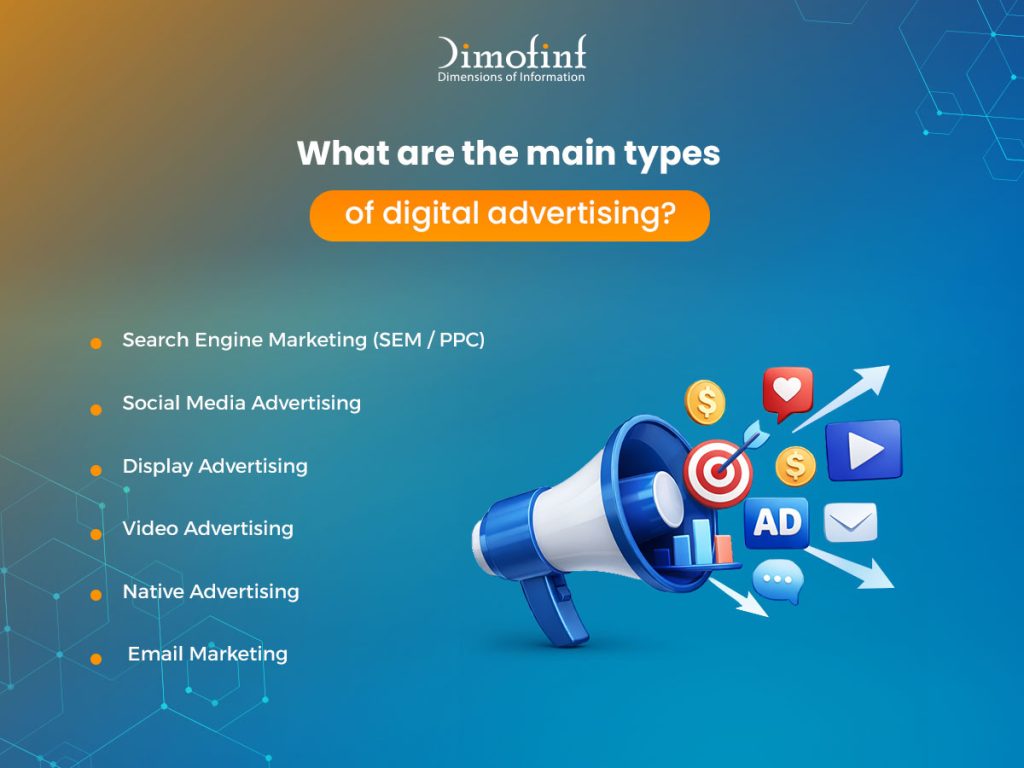
What are the main types of digital advertising?
Understanding the landscape requires breaking down the different formats and channels available to advertisers today. Each type serves a different purpose in the “marketing funnel.”
1. Search Engine Marketing (SEM / PPC)
This involves placing ads on search engine results pages like Google or Bing.
You bid on keywords. When someone searches for “best running shoes,” your ad appears at the top. This channel is best for capturing high-intent customers who are ready to buy.
2. Social Media Advertising
Paid content on platforms like Meta (Facebook/Instagram), TikTok, LinkedIn, and X.
How it works: You target users based on their interests, demographics, and social behaviors.
It’s the best channel for brand awareness, community building, and visual storytelling.
3. Display Advertising
These are the visual banners or “boxes” you see on news websites, blogs, and apps.
These ads are placed across a network of millions of websites like the Google Display Network.
It’s the best channel for retargeting people who already visited your site and broad awareness.
4. Video Advertising
Ads that appear before, during, or after video content (YouTube, Hulu, or social video).
Short-form or long-form video clips that can be skippable or non-skippable.
It’s the best channel for explaining complex products and emotional branding.
5. Native Advertising
Ads that are designed to match the look, feel, and function of the media format in which they appear. These ads blend in with organic content as “Sponsored content” articles or “Promoted” posts.
It’s the best channel for non-disruptive user experiences and establishing thought leadership.
6. Email Marketing
Directly reaching out to a list of subscribers via their inbox.
How it works: Newsletters, promotional offers, and automated “abandoned cart” reminders.
It’s the best channel for customer retention and nurturing long-term relationships.
How does digital advertising help generate leads or sales?
Digital advertising help in generating leads by triggering a specific action and engaging audience through buyer’s journey by:
1. High-Intent Targeting:
Digital ads capture people at the exact moment they are looking for a solution. For example, search ads target intent. If someone types “emergency plumber near me,” a digital ad places a business in front of that high-intent user instantly, leading to a direct phone call (lead) or booking (sale).
2. The Power of Retargeting
Most people don’t buy the first time they see a product. Digital advertising uses “pixels” or tracking codes to identify people who visited your site but didn’t purchase. You can then show them specialized “retargeting” ads with a discount code, which significantly increases the likelihood of a sale.
3. Frictionless Conversion Paths
Digital ads reduce the friction between seeing an ad and making a purchase by:
- Lead Generation Forms: Platforms like LinkedIn and Facebook allow users to submit their contact info directly within the ad, without ever leaving the app.
- One-Click Shopping: Instagram and Google Shopping ads allow users to buy a product directly from the image, turning interest into a sale in seconds.
How do businesses choose the right digital advertising platform?
With dozens of platforms available, businesses choose the right advertising platform based on three factors: the goal, the audience and the content.
Step 1: Determining the Marketing Goal
- For Awareness: Visual platforms like Instagram, TikTok, or YouTube are best for introducing a brand to new people.
- For Lead Generation: LinkedIn is the gold standard for B2B leads, while Facebook Lead Ads work well for local services.
- For Immediate Sales: Google Search is the most effective because it targets people actively searching for a specific product.
Step 2: Identifying the Audience Demographic
Each platform attracts a specific crowd:
- TikTok: Skews heavily toward Gen Z and younger Millennials (ages 13–29).
- Facebook: Offers the broadest reach across older Millennials, Gen X, and Boomers.
- LinkedIn: Best for professionals, decision-makers, and high-income earners.
- Instagram: Highly effective for lifestyle, home decor, and wedding-related products.
Step 3: Evaluating Content Type
Businesses must choose a platform that suits their creative capabilities:
- If a business has high-quality video content, YouTube and TikTok are the natural choices.
- If a business has text-based expertise or a complex service, Google Search and LinkedIn articles are more appropriate.
- If a business is highly visual (fashion, food, travel), Instagram is essential.
What are the most important KPIs in digital advertising?
Key Performance Indicators (KPIs) are the metrics used to determine if a digital campaign is successful. Because you can track almost anything online, it’s vital to focus on those metrics that actually impact the bottom line:
- Impressions: The total number of times your ad was displayed.
- Reach: The number of unique users who saw your ad.
- Click-Through Rate (CTR): CTR measures how compelling your ad creative is. A low CTR usually means your ad is either boring or being shown to the wrong people.
- Cost Per Click (CPC): This indicates how much you pay every time someone clicks your ad
- Cost Per Mille (CPM): This indicates how much you pay for 1,000 impressions.
- Conversion Rate (CVR): This indicator tells you if your website or landing page is doing its job of turning visitors into customers.
- Cost Per Acquisition (CPA): This indicator tells how much the ad costs to “buy” a customer. If your CPA is higher than the profit you make from a customer, your campaign is not sustainable.
In the end of viewing what is digital advertising, we can figure that it is built on data. Instead of showing an ad to everyone, we show it only to people who have shown interest in what you sell. You don’t have to guess if people are seeing your message. We have direct numbers for every cent you spend.
Maximize your global reach and accelerate your growth with the expert digital advertising solutions at Dimofinf.
FAQs
Which channel is best for direct conversions?
Which digital advertising channel is best for brand awareness?
What our customers say
Share this article

Website Design Company in Riyadh | Professional Web Design

Cheapest Website Hosting: Compare the Best Affordable Hosts

What Is a Minecraft Server? How It Works & Server Types
How to Check SEO Ranking: Track Your Google Keyword Positions
Generative Engine Optimization Tools: Best GEO Tools for AI Search
What Is Affiliate Marketing and How Does It Work?
Marketing Strategy: How to Build a Successful Growth Plan
How to find the best SEO company in Saudi Arabia in 2026?