
What is Python? Features, Uses, and Why It’s Popular

You’ve probably heard the name Python mentioned in tech circles lately, and there’s a good reason why. Think of it as a set of instructions that reads almost like plain English. Whether you want to launch a website, automate a repetitive task at work, or explore the world of AI, Python is the starting point to make it possible.
It’s straightforward, incredibly powerful, and the perfect tool for anyone looking to build something great online.
So today, we’ll discuss “what is python“, its features and its most common uses.

What is Python programming language?
To start with answering “what is python”, we say Python is a high-level, general-purpose programming language, designed to be readable for humans. This means you can use it for almost anything, from building a simple calculator to running the complex algorithms behind modern social media feeds.
In real-world usage, the main thing you notice is how much it looks like standard English. The creators wanted to make sure that a developer could read a block of code and understand what it does without needing a secret decoder ring. We call this syntax, and in Python, it is famously clean.
How it works in most production environments
In most production environments, Python acts as an interpreted language. You don’t have to go through a long compilation phase where the computer spends minutes turning your code into machine language before you can see if it works. Instead, an interpreter processes the code line-by-line.
This makes the development process much faster for you. If there is an error on line ten, the program stops right there and tells you. We find this incredibly helpful when we are trying to fix bugs or test new ideas quickly.
Key features you should know
For Those who asking “what is python” and completely new to this language, there are some features of python you need to know:
- It is versatile: You can use it for web development, data analysis, artificial intelligence, and scientific research.
- The library support is massive: Think of libraries as pre-written toolkits. If you need to connect to a database or resize an image, someone has likely already written the code for it.
- It has a massive community: Because so many people use it, you can find answers to almost any problem online within seconds.
- It works everywhere: You can run the same script on a Windows laptop, a MacBook, or a Linux server without changing much.
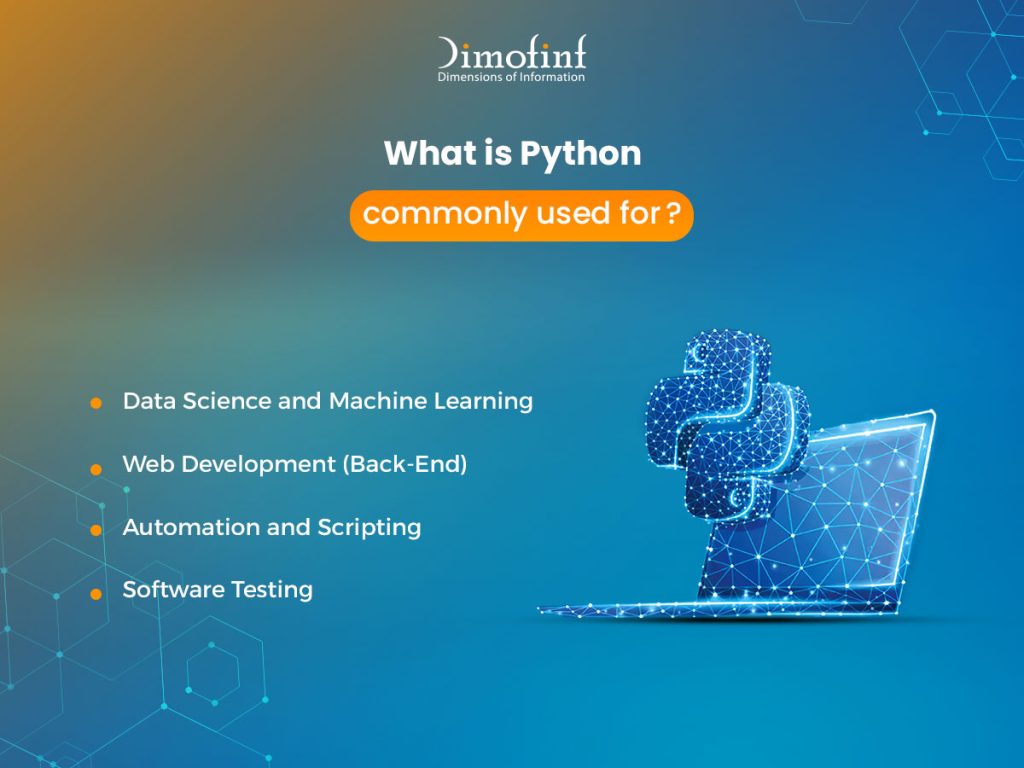
What is Python commonly used for?
In real-world usage, you will find Python behind the scenes of many services you use every day. It is not just for one specific task; its flexibility is why we see it in almost every industry.
Data Science and Machine Learning
In most production environments involving data, developers use Python to sift through massive amounts of information. It handles the math and the sorting. If you have ever seen a recommended list on a streaming site, Python was likely involved in calculating those suggestions. We rely on it because it can take a million rows of data and turn them into a readable chart or a prediction about future sales.
Web Development (Back-End)
While you don’t use Python to design the buttons or colors you see on a screen, we use it to build the brain of the website. This is called the back-end. It manages user accounts, connects to databases, and ensures that when you click buy, the transaction actually happens.
Automation and Scripting
We often use Python to handle the boring stuff. If you have a thousand files that need to be renamed or a spreadsheet that needs to be updated every morning at 8:00 AM, you can write a short Python script to do it for you. In most professional settings, this is called scripting. It saves us hours of manual labor and removes the risk of human error.
Software Testing
Before a new app goes live, it needs to be tested. We use Python to write automated tests that click every button and fill out every form much faster than a person could. This ensures that a tiny change in one part of the code doesn’t accidentally break something else.
How is Python used in web development?
When we ask “what is python’s relation with web development”, we are talking about Server-Side or Back-End development to build dynamic websites, APIs, and web applications as follows:
Communicating with Databases
We use Python to interact with data through ORM (Object-Relational Mapping) as if it were just standard Python objects. This makes it much harder to make mistakes and easier to read the code later.
Business Logic and Data Processing:
This is where the brain of the app lives.
If you are building a travel site, Python calculates the cheapest flight based on your dates.
If you are on a social media site, Python determines which posts show up in your feed based on your interests.
Authentication and Security
We use Python to hash and salt passwords so they aren’t stored as plain text, manage user sessions to keep you logged in as you move from page to page and prevent common attacks like SQL injection or Cross-Site Scripting.
Integrating APIs
Most modern websites need to talk to other services. For example, a store might need to talk to Stripe for payments or Google Maps for shipping tracking. Python has incredible libraries that make connecting these different services seamless for us.
What are some popular Python frameworks?
While Python is a powerful language on its own, its ecosystem of frameworks is what makes it so dominant in the industry. Here are some of the most popular frameworks used today.
- Django: The most popular batteries-included framework. It follows the Don’t Repeat Yourself (DRY) principle and includes a built-in admin interface, ORM (database manager), and robust security features.
- Flask: Known for its simplicity and unopinionated nature. It is easy to learn and perfect for prototyping. Flask framework is best for small applications, personal projects, and learning the basics of web development.
- Tornado: Originally developed at FriendFeed and acquired by Facebook, it is designed for long-lived connections like WebSockets.
- FastAPI: The rising star of the Python world. It is designed specifically for building APIs with modern Python features. It is incredibly fast, rivaling Node.js and Go in performance.
- Streamlit: A specialized framework that lets you turn data scripts into shareable web apps in minutes, with no front-end experience required.
Which framework should you choose?
- Beginners: Start with Flask to understand how the web works, or Django if you want to get a professional-grade site up quickly.
- Performance Junkies: Go straight to FastAPI.
- Data Scientists: Use Streamlit to showcase your models.
How does Python differ from other programming languages?
Python follows a “Batteries Included“ philosophy. Its standard library is massive, containing tools for everything from handling ZIP files to creating web servers and parsing JSON. In many other languages, you have to find and download third-party packages to do these basic tasks.
Quick Comparison Table
| Feature | Python | Java | C++ | JavaScript |
| Primary Use | AI, Web, Data | Enterprise, Android | Systems, Games | Web Front-end |
| Speed | Average | High | Very High | High |
| Ease of Learning | Very Easy | Moderate | Hard | Easy -Moderate |
| Readability | Exceptional | Moderate | Low | Moderate |
Summary
Python’s main differentiation from other programming languages isn’t performance; it’s productivity. While a C++ program might run 10 times faster, a Python developer can often write the same program in 1/10th of the time.
Conclusion
When people ask, “what is python“, the answer is a high-level, interpreted, general-purpose programming language designed to prioritize the developer’s time and clarity over raw hardware performance.
While other languages might offer more control over system resources, Python provides a versatile ecosystem that allows beginners and experts alike to build complex systems, from web applications to artificial intelligence, with fewer lines of code than almost any other major language today.
Share this article

How to Create a Website Using Free Web Hosting Step by Step
shared hosting vs vps hosting: Which one is better for your business?
What Is a Ransomware Attack? Definition, Examples & Prevention

Best types of website design for your business in 2026
Best types of website design for your business in 2026
best web hosting server